

From Amenity to Memory: What Makes a Hotel Gift Worth Keeping?
A hotel stay is made up of hundreds of small details.
Some are noticed immediately.
Others only reveal their value later.
A guest may encounter dozens of objects during a stay, but only a few will be remembered — and even fewer will be taken home.
That difference is what makes hotel gifting interesting.
The most successful pieces are not simply beautiful or useful. They become part of the stay itself.
A hand fan used every afternoon on a warm terrace.
A lightweight textile that moves from pool to lunch.
A bespoke keyring that remains attached to a bag long after checkout.
A resort tote that travels from the room to the beach and eventually home.
A scent that becomes unexpectedly connected to a place.
When an object becomes part of a routine, it starts to carry memory.
A memorable hotel gift does not need to be extravagant
Luxury is often associated with scale, decoration or price.
But the objects guests remember are not always the most elaborate ones.
They are the ones that feel considered.
That feeling can come from material, proportion, texture, colour, utility or simply from the fact that the object belongs naturally to the property.
A subtle engraved detail can feel more special than an oversized logo.
A carefully chosen textile can feel more luxurious than something more ornate.
A bespoke keyring can become meaningful if its form, material and finish connect directly to the hotel.
The value lies in relevance.
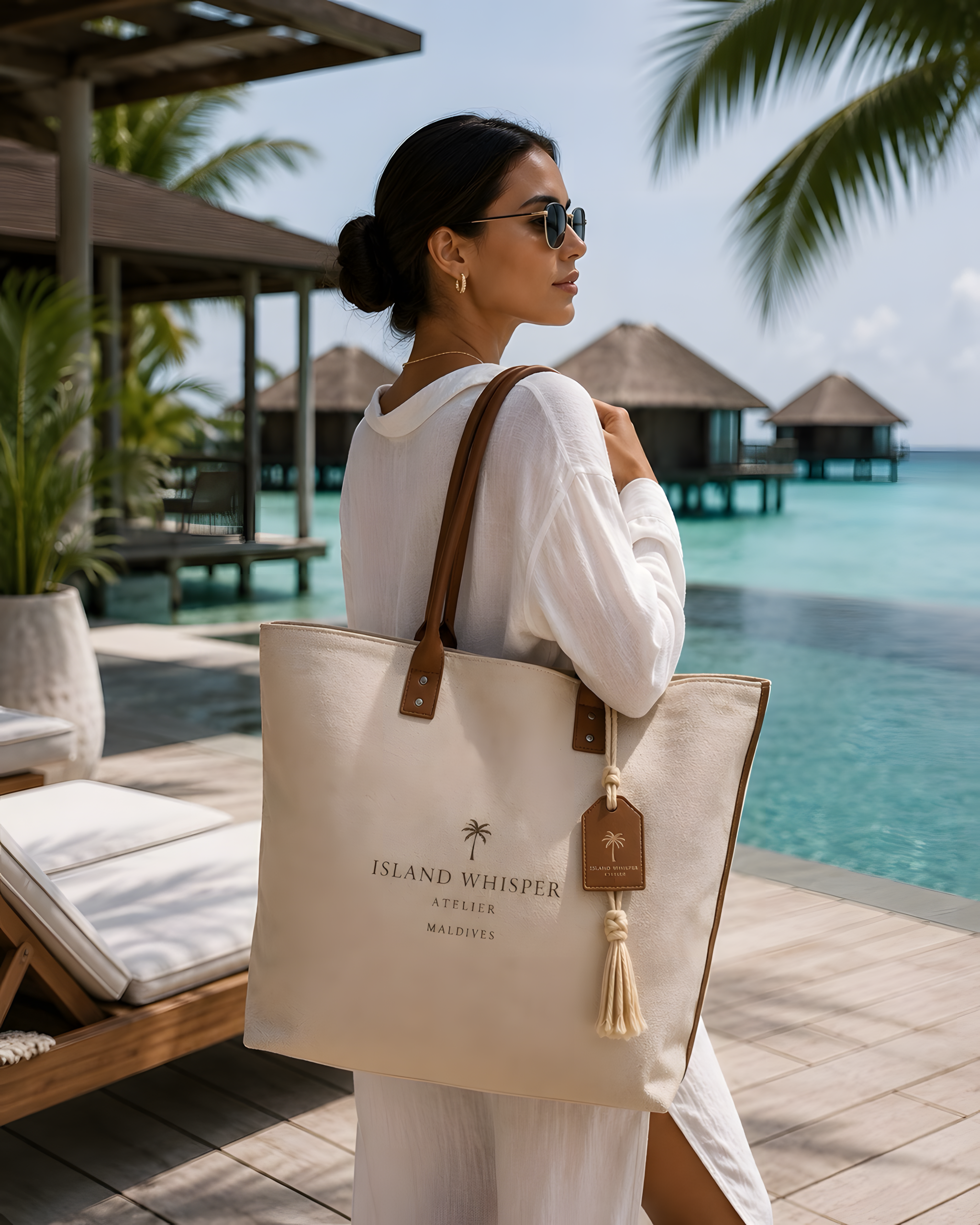
Luxury Resort Tote Designed for the Guest Journey
Sense of place without turning into a souvenir
One of the most interesting challenges in hospitality gifting is creating a connection to the destination without making the object feel like a souvenir.
That connection does not need to be literal.
A colour can come from the surrounding landscape.
A pattern can reference architecture.
A botanical detail can come from the property itself.
A material can echo the interior.
A scent can recall the local environment.
The aim is not to place the destination on the object.
It is to make the object feel as though it could only belong there.
That is why we do not begin with a fixed catalogue at Island Whisper Atelier.
We begin with the property, the destination and the guest experience.
The object comes afterwards.
Use matters more than display
One of the most useful questions to ask is simple:
Will the guest actually use it?
An object that remains untouched on a table may look beautiful, but it has very few opportunities to become part of the experience.
Objects that move with the guest behave differently.
This is one of the reasons the hand fan remains our signature piece.
In a warm-weather property, it can move from the room to the terrace, to lunch, to the pool and back out again in the evening.
The same logic applies to a resort tote, a pareo-style textile, a bespoke keyring or a small accessory designed around the rhythm of the stay.
The more naturally the piece is used, the stronger the connection can become.
Branding should support the object, not overwhelm it
Luxury hospitality does not need to rely on obvious branding.
A hotel can be present through a fine engraving, a colour, a material, a pattern or a finishing detail.
Often, the more discreet the branding, the more desirable the object becomes.
The strongest pieces do not need to announce where they come from.
They simply feel right for that property.
Presentation is part of the experience
The object itself is only one layer.
How it is presented can completely change how it is perceived.
A bespoke piece may arrive in a custom box, a soft pouch, a carefully designed case or a full presentation set developed specifically for the hotel.
Luxury gift boxes and bespoke packaging can become part of the storytelling, not simply a way to protect the product.
The materials, colours, internal layout, engraving and finishing can all be considered as part of the experience.
Because the moment of receiving the gift matters too.
The best hotel keepsakes have a second life
The real test often comes after checkout.
Does the piece disappear into a drawer?
Or does the guest continue to use it?
The hand fan that comes out again the following summer.
The tote that travels to another beach.
The keyring that stays in everyday use.
The textile that returns on another holiday.
The scent that unexpectedly brings someone back to a place.
This second life is what gives a hotel gift lasting value.
The property remains present without needing to be present physically.
From amenity to memory
Perhaps the better question is not:
What should we give the guest?
But:
What could become part of the stay?
A gift becomes memorable when it feels connected to the place, useful enough to be used, and considered enough to be kept.
That is when an amenity becomes something more.
It becomes a memory.
-
Hotels can develop bespoke hand fans, luxury keyrings, textiles, resort totes, accessories, sensory objects, custom packaging and wider gifting collections created specifically for the property. The starting point does not need to be a particular product; it can be the destination, the hotel identity, a guest experience or a specific moment within the stay.
-
The most memorable hotel gifts usually combine usefulness, thoughtful design, a sense of place and a genuine connection to the guest experience. They do not need to be extravagant; they need to feel relevant to the property and desirable enough to use, keep or take home.
-
Destination identity can be expressed subtly through colour, materials, botanical references, architecture, artwork, texture or scent. The aim is not to reproduce local symbols literally, but to create a piece that feels naturally connected to that specific place.
-
Not necessarily. A hotel’s identity can be expressed through discreet engraving, colour, material, pattern or finishing details. In many projects, subtle branding makes the object more desirable and gives it a longer life beyond the hotel.
-
An amenity mainly serves a purpose during the stay. A keepsake has the potential to continue being used after checkout. The same object can fulfil both roles when it is useful during the stay and special enough for the guest to keep.
-
Yes. We create bespoke luxury keyrings for hotels, resorts and hospitality projects, developing the materials, colour, form, engraving and presentation around the identity of the property. They can become part of a welcome gift, VIP gifting, a hotel opening or a wider guest experience.
-
Yes. We can develop bespoke luxury boxes, cases and packaging to accompany hand fans, keyrings and other custom pieces. Materials, colour, internal presentation, engraving and finishing can all be developed so that the moment of receiving the gift feels considered and consistent with the hotel or brand.