

What Makes a Hotel Amenity Worth Taking Home?
There is a revealing moment in almost every hotel stay.
The guest is packing.
Some objects remain in the room without a second thought.
Others find their way into the suitcase.
That difference is fascinating.
Why does one amenity feel disposable while another feels worth keeping?
For luxury hospitality, the answer matters because the object that leaves with the guest can continue telling the story of the property long after check-out.
At Island Whisper Atelier, this is one of the questions we explore when developing collections for luxury hotels and resorts.
The most desirable objects usually share several qualities.
They are useful.
They are distinctive.
They feel connected to the place.
And, perhaps most importantly, they do not feel like generic hotel merchandise.
It begins with desirability
A hotel amenity can be beautifully branded and still remain untouched.
The first question should therefore not be:
“How prominently can we place the hotel logo?”
It should be:
“Would someone genuinely want this?”
Desirability can come from many places.
A material that feels beautiful in the hand.
An illustration worth looking at.
An object that solves a small problem.
A shape that feels unexpected.
A scent that immediately recalls the destination.
Or simply something that is useful during the stay and useful again afterwards.
The strongest pieces often achieve several of these at once.
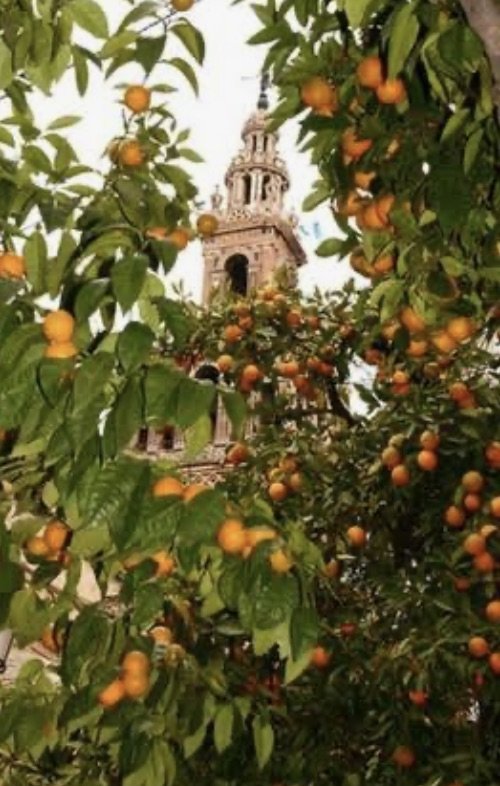
Inspired by Seville’s orange trees, this bespoke hand fan captures the warmth, colour and character of the destination through original artwork and thoughtful craftsmanship.
A sense of place makes the object harder to replace
Guests can buy a generic tote bag almost anywhere.
The same is true of a pouch, a scarf or a fan.
What makes a hotel version interesting is not the category itself.
It is why that particular object could only have come from that particular place.
This is why our bespoke design approach starts with the destination rather than a fixed catalogue.
A property surrounded by tropical landscape may inspire one visual language.
A historic European city may suggest something entirely different.
A safari lodge may begin with wildlife, earth tones, natural fibres and the rhythm of the landscape.
The object becomes desirable because it contains something specific.
It carries a fragment of the experience.
The hand fan: functional, visual and memorable
The handcrafted fan remains Island Whisper Atelier's signature product.
Part of its appeal in hospitality is that it performs several roles at the same time.
It is practical in warm destinations.
It is highly visual.
It can become part of an event or guest moment.
It is easy to travel with.
And it provides an unusually beautiful surface for original artwork.
A bespoke luxury hand fan can begin with a destination, an architectural detail, a botanical reference or an original watercolour.
Once the guest takes it home, it no longer functions simply as a hotel amenity.
It becomes an object associated with a particular trip.
That is a far more valuable relationship.
Useful during the stay, desirable afterwards
One of the simplest tests for a hospitality object is to ask two questions:
Will the guest use it while they are here?
Will they still want it when they leave?
A pool towel that transforms into a pareo can move from sun lounger to lunch and eventually into a suitcase.
A well-designed resort bag can travel between room, beach and pool — and later become a summer bag at home.
A compact pouch can begin as an in-room accessory and continue as a travel piece.
A hand fan can be useful at the property and then become a lasting reminder of the destination.
This idea of continuation is important.
The hotel experience does not necessarily need to end at check-out.
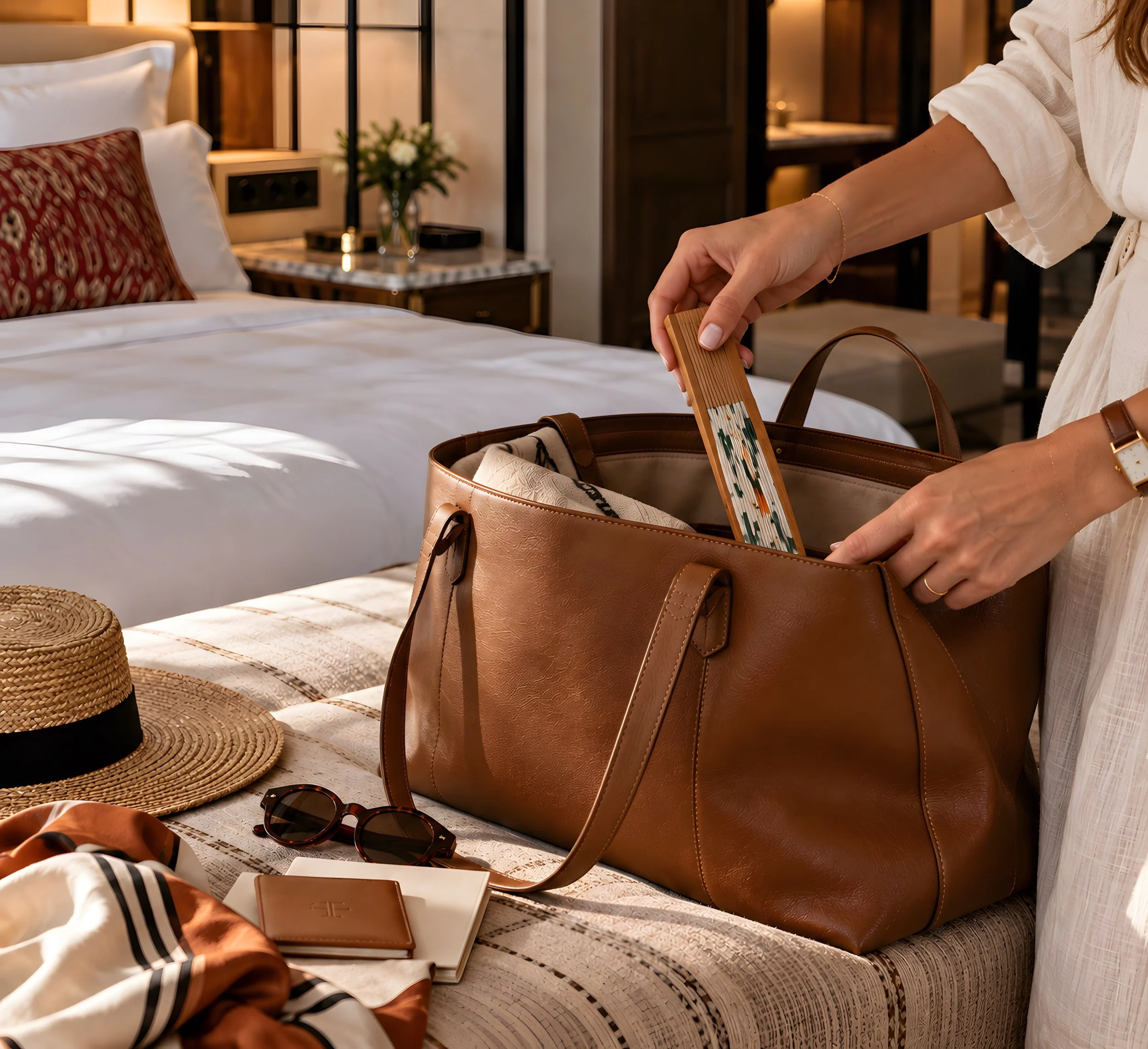
A simple gesture that reflects the guest journey: a bespoke hand fan designed to move effortlessly from room to pool, and from pool to beach.
Branding should not destroy desirability
There is a temptation in hospitality gifting to make the brand extremely visible.
But luxury often works differently.
A beautifully engraved wooden rib, an embossed leather tag, a subtle woven label or a particular colour may communicate identity more successfully than an oversized logo.
The guest should ideally want the object even if they momentarily forget that it is branded merchandise.
That is a useful standard.
Because when the object is desirable in its own right, the brand associated with it becomes part of a positive memory rather than an advertisement.
Material matters
The perceived value of an object is rarely determined by design alone.
Guests experience materials physically.
They notice the difference between something rigid and something soft.
Between synthetic-looking and tactile.
Between generic hardware and considered finishing.
Between an object designed to last for an afternoon and one that feels capable of travelling for years.
Materials therefore communicate something about the property itself.
A beautifully finished object suggests care.
And care is one of the fundamental languages of luxury hospitality.
Sensory memory goes beyond what guests can see
A memorable amenity does not have to be purely visual.
Scent can create an extraordinarily powerful association with place.
This is why we increasingly think about sensory brand experiences alongside physical design.
Imagine a sculptural soap whose form references the destination.
Now imagine that the botanical detail represented on its surface also informs its fragrance.
Suddenly, shape, touch, scent and place are working together.
The starting question changes from:
“What soap should we order?”
to:
“What should this destination smell like?”
That is a much richer creative brief.
Scarcity can increase emotional value
An object created specifically for one property has another advantage.
It cannot simply be found everywhere.
That scarcity does not have to mean artificial exclusivity.
It may simply mean that the artwork, colour palette or form was developed for that particular destination.
The guest discovers something available only because they were there.
That gives even a relatively small object greater emotional value.
A collection does not need dozens of products
Luxury hospitality collections do not become stronger simply because they contain more objects.
Often, the opposite is true.
A small number of well-considered pieces can create a much stronger impression.
One signature object.
One pool or beach piece.
One sensory touchpoint.
Perhaps one VIP or gifting piece.
What matters is the relationship between them.
Do they feel like they belong to the same world?
Do they appear at meaningful moments of the guest journey?
Do they reinforce the property's sense of place?
This is where creative direction becomes more important than simply sourcing products.
From object to memory
The most successful hospitality objects occupy an interesting space.
They are functional, but they are not purely functional.
They are branded, but they do not feel like advertising.
They tell a story, but they do not need to explain that story in paragraphs of text.
They simply feel connected to somewhere.
That is ultimately what makes an amenity worth taking home.
Not the fact that it is free.
The fact that it feels worth keeping.
You can explore examples of how we translate destination and story into physical objects in our selected projects.
-
A memorable amenity combines usefulness, design quality and a genuine connection to the hotel or destination. Guests are more likely to remember objects that feel specific rather than generic.
-
No. Branding can be subtle. Engraving, colour, materials, artwork or small details can communicate identity without making the object feel promotional.
-
Objects that remain useful after the stay are particularly strong candidates: hand fans, resort bags, scarves or pareos, travel accessories, pouches and carefully designed gifting pieces.
-
Yes. Destination-led design can draw from architecture, landscape, flora, heritage, local materials, colour and other distinctive characteristics of the property and its surroundings.
-
Yes. Hand fans combine function, portability and a strong visual surface for original artwork, making them particularly suitable for warm-weather properties, resorts, events and guest gifting.
-
Yes. Projects can range from a single signature piece to broader collections spanning guest gifting, textiles, accessories and sensory experiences.
-
For a hotel opening, bespoke commission or guest experience project, contact us